When you buy through links on our articles, Future and its syndication partners may earn a commission.

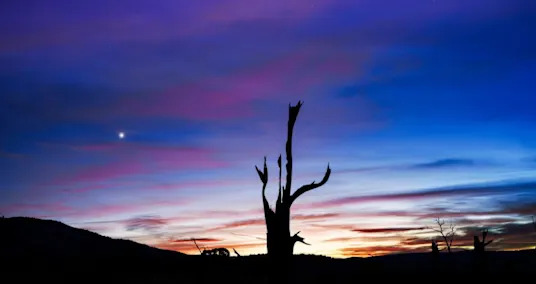
Of the five bright naked-eye planets, the two most favorably positioned for viewing during April are in the evening sky. Dazzling Venus, low in the west-northwest for about two hours after sunset, and brilliant Jupiter, which soars high in the south-southwest at dusk and remains visible until well after midnight, accompanied by the "Twin Stars" of Gemini the Twins, Pollux and Castor.
The other planets, Mercury, Mars and Saturn, remain quite low to the east-southeast horizon and mired in the bright light of the advancing dawn, making all three rather difficult to see. Binoculars will certainly be beneficial in making a sighting of one or all of these worlds. Saturn will make some progress in increasing its altitude and edging into a somewhat darker background sky, but not until the end of the month.
In our schedule, remember that when measuring the angular separation between two celestial objects, your clenched fist held at arm's length measures roughly 10 degrees. Here, we present a schedule below which provides some of the best planet viewing times, as well as directing you to where to look to see them.
Mercury
Mercury is at its greatest western elongation on April 3. But while it ranges as far out as 28 degrees from the sun as viewed from mid-northern latitudes, this is mostly directly off to the sun's right, placing the planet quite low above the horizon. This +0.3-magnitude planet rises less than an hour before sunrise and shortly after coming above the horizon might be located with binoculars about 10 degrees south of the due east point. Only from the more southerly states is the planet likely to be visible to the naked eye. The vantage from which Mercury is best seen at this apparition is from the Southern Hemisphere. Around midmonth, Mercury will be near Mars and Saturn (see "Mars" below).
Venus
Venus is popularly regarded as the "sister planet" because it's similar in size and gets a little higher each week during April. It remains small and roundish in telescopes this month, but from early April until early September, Venus will be at least 10 degrees above the horizon 45 minutes after sunset (though never very high), and during that period, we will see its disk grow and enter its crescent phase.
On the evening of April 18, soon after sunset, look low toward the west-northwest for a view of a slender 1½-day old crescent moon, just 4% illuminated. And situated about a half-dozen degrees to its upper left is the steady, dazzling light of Venus. On the evening of April 23, Venus makes its closest approach to the Pleiades star cluster, passing about 3½ degrees to their lower left, making for a lovely sight in binoculars. And on that same evening, Venus passes just three-quarters of a degree to the right of the sixth-magnitude Uranus; a rather close approach will serve as a convenient opportunity for identifying this greenish world in a small telescope or binoculars without the need to consult a sky map.

Mars
Mars is in the same vicinity as Mercury and Saturn and increases its elongation to 24 degrees west of the sun by month's end. But at magnitude +1.2, it will be the most difficult of the three morning planets to find in the bright twilight.
On what date will Mars first be seen with the naked eye? Since the planet's elongation is increasing so slowly, the answer is difficult to predict, but southerly observers will succeed sooner. On the morning of April 16, observers closer to the tropics will be treated to a pre-sunrise grouping of Saturn, Mercury, Mars and a very narrow crescent moon. The farther south you are, the higher these four objects will be. Search with binoculars before sunrise.
Jupiter
Jupiter, after Venus, is the first star-like object that appears at dusk, glimmering high in the west through much of this month, with the two leading stars of Gemini, Pollux and Castor, floating even higher above it. This, the largest of all the planets, offers telescope users fine views for several hours after sunset. On the evening of April 22, a fat crescent moon will appear about 3 degrees above and to the right of Jupiter.

Saturn
Saturn at magnitude +0.9, finally begins appearing out from behind the sun in late April's dawn glow. By month's end, it rises ahead of the sun by about an hour, but you'll still have to look very low in the east to get even a fleeting glimpse of it before it gets overwhelmed by the brightening sky. Around midmonth, Saturn will be near Mars and Mercury (see "Mars" above).
If you're looking for a telescope or binoculars to observe the night sky, our guides for the best binocular deals and the best telescope deals can help. Our best cameras for astrophotography and best lenses for astrophotography can help you get ready to capture the next stunning skywatching event.
Joe Rao serves as an instructor and guest lecturer at New York's Hayden Planetarium. He writes about astronomy for Natural History magazine, Sky and Telescope, The Old Farmer's Almanac and other publications.
latest_posts
- 1
 Best Amusement Park Bite: What Do You Very much want to Crunch On?
 - 2Top 20 Style Brands for Pioneers
- 3Misremembering might actually be a sign your memory is working optimally
- 4The risk of falling space junk hitting airplanes is on the rise, experts warn
- 5Thyssenkrupp to suspend electrical steel production at French site





- Solid Living Tips: Experiences from a Wellness Fan
- Mom warns of Christmas gift hazard as daughter recovers in hospital
- 4K televisions for Extreme Film Watching Experience
- Changes to CDC website spark debate over autism and vaccine misinformation
- Vote in favor of your Number one method for praising a birthday
- Vote in favor of your Favored Kind of Scarf
- Instructions to Pick the Ideal SUV Size for Seniors
- Chinese astronauts’ return to Earth delayed over fears spaceship damaged by debris
- What's the new 'Knives Out' mystery about? Everything to know about 'Wake Up Dead Man,' including who's in the cast and what the reviews say.


